How Gutter Guards Handle Oak Leaves and Acorns in Reddick
@spenceryoye093
October 18, 2026 · 14 min read
Reddick homeowners know the pattern. Trees shed, summer rain arrives hard and fast, and the gutters that looked fine a week ago suddenly start spilling over the edge. If your property has live oaks nearby, the problem has its own personality. Oak leaves do not behave like broad maple leaves in a cooler climate. They are smaller, often leathery, and they mix with twigs, grit, and acorns in a way that can create a stubborn clog. Once that mix gets wet and starts to break down, it packs tighter than many people expect.
That is where gutter guards enter the conversation, but it helps to set expectations honestly. A guard is not a magic lid that makes the gutter disappear from your maintenance list forever. In Central and North Florida, especially through the rainy season and during tropical weather, the real job of a guard is to reduce how much debris drops into the trough, slow the formation of dense clogs, and make cleanup easier before stormwater gets out of hand.
For homes around Reddick, that matters for more than convenience. Florida extension guidance consistently warns that leaves, needles, and yard debris can clog gutters and storm drains, especially when people are trying to get ready for storms. It also points out that leaf litter and acorns can wash into waterways as stormwater pollution. So this is not just a matter of avoiding a Saturday chore. A gutter system that sheds debris better and drains properly is part of basic storm readiness and responsible property care.
Why oak debris is such a headache in this part of Florida
Live oaks are beautiful shade trees, but they ask a lot from a roofline. Their leaves tend to be small enough to slip into weak points, and acorns add a completely different kind of load. Leaves alone can mat together and block water. Acorns alone can roll, collect at corners, or stack near outlets. Put them together, then add humidity and repeated rain, and the result is a compact organic buildup that can slow water well before the gutter looks completely full from the ground.
That is one reason a homeowner may think the gutters are "mostly clear" and still have overflow in a downpour. The water is not always being blocked by one dramatic plug. Sometimes it is a damp layer of leaf fragments and acorns that narrows the path and keeps water from moving to the outlet quickly enough.
In Reddick and surrounding areas, the seasonal pressure on gutters can be intense. The summer rainy season can dump a lot of water in a short window, and tropical-storm season raises the stakes. A half-working gutter may get by on a mild shower. It may fail completely in a Florida cloudburst.
What a gutter guard actually does with oak leaves
The simplest way to think about a gutter guard is as a traffic controller. It tries to let water in while keeping larger debris on top or directing it away from the gutter opening. With oak leaves, that can work fairly well if the debris lands loosely and has a chance to dry, shift, or blow off before it gets saturated and pressed down by repeated rain.
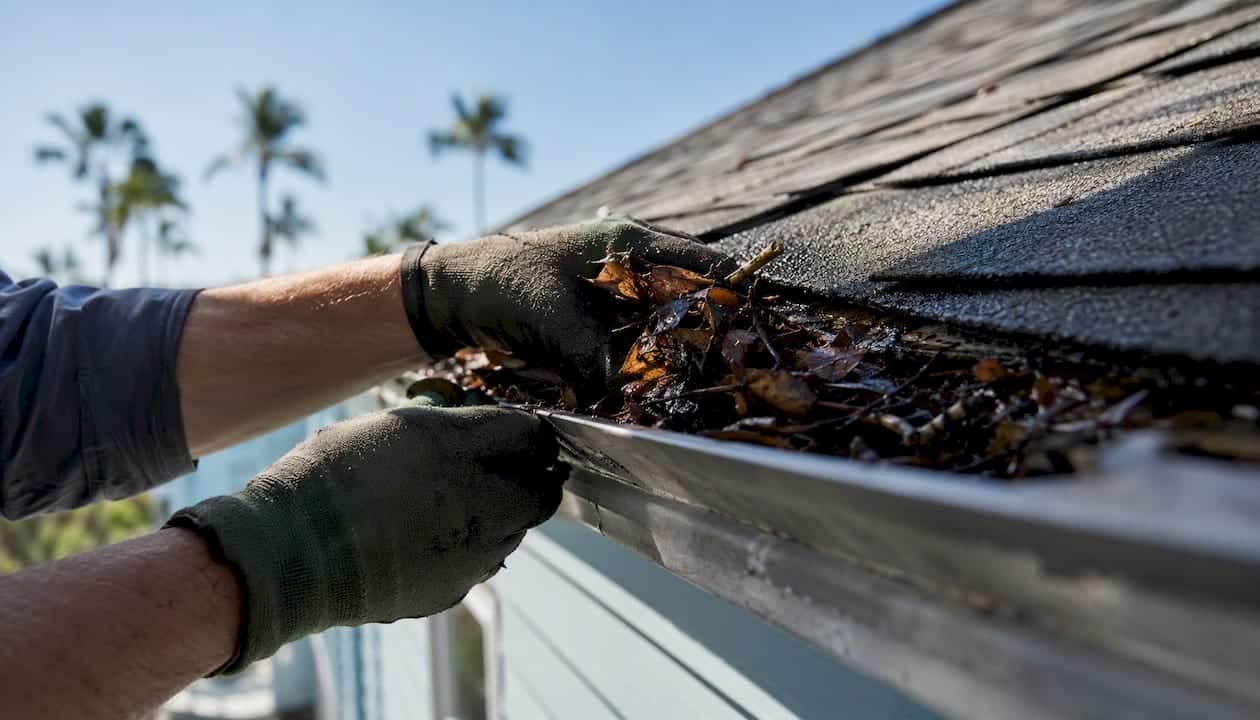
The trouble starts when leaf volume is heavy and conditions stay damp. Oak leaves can overlap and create a blanket on top of the guard. Even when the guard keeps those leaves out of the trough itself, the top surface can still need attention. This is why homeowners sometimes hear "gutter guards stop clogs" and then feel disappointed. The better phrasing is that guards often change the kind of clog you are dealing with. Instead of decomposing material buried inside the gutter, you may be removing material sitting on top of the guard or clearing buildup at the edge and around the outlet.
That is still a meaningful improvement. Wet organic sludge inside a gutter is harder to spot, heavier to remove, and more likely to interfere with downspout flow. A surface layer is usually easier to see and address before a storm.
Acorns are a different test
Acorns make gutter guard performance much more interesting. They are round, hard, and heavy enough to behave differently from leaves. Depending on the roof slope and where the trees overhang the house, acorns may bounce, roll to low points, or lodge against transitions in the gutter line. They can also collect where water needs a clean path most, near the outlet to the downspout.
A guard can help by reducing direct entry into the gutter cavity, but it does not make acorns irrelevant. If enough acorns gather on top of the guard or at the leading edge, they can trap leaf fragments around them. Over time, that becomes a small dam. Once that dam catches more debris, performance drops fast.
That is why homes under heavy oak canopy need realistic planning. You are not just trying to block leaves. You are trying to manage a mixed debris load with very different shapes and weights, through months when rain can arrive in sheets.
The biggest myth, maintenance free gutters
No gutter guard worth discussing should be sold as a lifetime pass out of maintenance, especially in a Florida setting with oaks, pine needles, humidity, and storm season. UF/IFAS guidance is plain about the broader principle: gutters and downspouts need to be cleaned as needed, and organic buildup should be removed, especially in summer. Guards can reduce how often the inside of the gutter needs that work, but they do not erase the need to inspect the system.
This is also where local tree mix matters. Some homes in the region fight both oak debris and pine needles. If that sounds familiar, the conversation often overlaps with what people search for when they ask about gutter guards for pine needles Florida. Fine, narrow debris behaves differently from leaves, and if your lot has both pines and oaks, a guard has to deal with two opposite challenges at once. Larger openings may shed acorns but admit more small material. Tighter openings may exclude more fine debris but still require surface cleaning if leaves form a mat. There is no one-size answer that beats every tree on every lot.
Why water volume matters as much as debris
A gutter system can only perform as well as its drainage path. Guard or no guard, water has to enter the gutter, travel the full run, and exit through downspouts fast enough to keep up with local rainfall. Florida building requirements make the broad point clearly: gutters and downspouts need to be sized and discharged in accordance with code, and the system should be securely fastened with corrosion-resistant hardware.
That means the discussion should never stop at the guard alone. On some homes, the real issue is undersized or poorly laid-out drainage. If the trough is too small, if the downspouts are not handling runoff efficiently, or if the discharge area is not set up well, then the guard may get blamed for a problem that started with design.
This is where topics like gutter sizes for Florida homes and downspout drainage Newberry FL become part of the same practical conversation. A home facing intense rain needs a complete water-management approach, not just a cover over the gutter opening. The guard can help keep debris out, but capacity and discharge still decide what happens in a storm.
The shape and material of the gutter still matter
Most homeowners first notice the guard because it is visible. Contractors usually notice the gutter body first. If the gutter is loose, poorly pitched, undersized, or already holding standing debris and organic muck, adding a guard does not fix the foundation problem.
In Florida, metal and approved plastic systems are standard territory under building rules, with secure fastening especially important. Around this region, aluminum gutters Central Florida are a common part of the conversation because aluminum is widely used and practical. The same goes for styles like K-style gutters Lady Lake FL, which many homeowners recognize from local estimates and product discussions. The article title here is about oak leaves and acorns, but the deeper truth is that guards perform best when they sit on a sound gutter system that already drains correctly.
If a home has older sections pulling away from the fascia, sagging runs, or joints that leak, it may be smarter to address those conditions before focusing on add-ons. Sometimes that means a localized gutter repair Wildwood FL type of job in spirit, meaning you correct a few sections and improve support. Sometimes it points toward a larger gutter replacement Gainesville FL style decision, especially if the system is at the end of its serviceable life or the layout no longer suits current runoff demands. And on homes where long continuous runs make sense, people often ask about seamless gutters Ocala FL because fewer joints can mean fewer places for leaks and debris snags to develop. The product names vary by market, but the principle is universal: a guard cannot rescue a failing gutter.
How guards usually help in oak country
On homes shaded by oaks, the best case for gutter guards is straightforward. They can cut down the volume of leaves and acorns that settle inside the trough, reduce the formation of wet compost-like sludge, and make visual inspections simpler. That is valuable because problems are easier to catch when debris stays on the surface instead of disappearing into a hidden mass near the downspout opening.
They also help with timing. During storm prep, every saved hour matters. Florida guidance specifically notes that gutters and storm drains can clog with debris and should be cleared before severe weather. A guarded system may still need a quick sweep or blow-off, but that is often less labor than digging decomposed material out of a full gutter just before rain bands arrive.
There is also a cleanup benefit after the storm. When leaf litter and acorns stay more contained near the roof edge rather than being pulped deep in the gutter, it is easier to remove and keep out of the wider drainage path around the home.
Where guards struggle
It is only fair to say where problems can still show up. Heavy leaf drop combined with repeated rain can cause debris to cling to the top surface. Valleys in the roof can concentrate runoff and push more debris to one section than the rest of the system sees. Corners and downspout entries remain vulnerable because they are natural collection points. Acorns can create tiny blockages that become larger ones once wet leaf fragments gather around them.
Homes with mixed debris loads, especially oaks plus pines, are another challenge. Pine needles can weave together, and oak leaves can pin them in place. If you have seen this on a roof edge, you already know it forms a surprisingly durable mat. That is why people who have struggled with gutter cleaning Fruitland Park FL type conditions often discover that the cleaning task changes after guards are installed, but it does not disappear. The location of the debris changes. The need to keep water moving does not.
Signs your guard system is not keeping up
A guarded gutter can look tidy from the yard and still underperform. The clues are usually subtle at first, then obvious once a heavy storm arrives.
- Water spilling over one section while the rest of the gutter seems normal
- Staining or dark streaks below corners or near a downspout outlet
- Debris collecting repeatedly in the same spot on top of the guard
- Rainwater backing up at roof edges during a hard shower
- Downspouts that trickle weakly even when rain is falling hard
Those signs usually point to a pinch point rather than a total system failure. The trouble may be at an outlet, a low seamless gutters for Florida homes spot, or a section where leaves and acorns are building a surface dam. Catching that early matters because Florida rains are not patient.
The role of routine inspection in storm season
For Reddick homeowners, the smartest habit is not constant cleaning. It is consistent checking. Before the wettest stretch of summer, and again before tropical weather becomes a real concern, take a look at the roof edge, the top of the guard, and the downspout discharge areas. You are looking for buildup, not perfection.
That rhythm lines up with what storm readiness actually requires in Florida. Storm ready gutters Florida is not really a product category. It is a maintenance standard. A storm-ready system is one that is secure, draining, and free of the kind of organic buildup that turns a manageable shower into an overflow event.
It is also worth remembering the environmental side. UF/IFAS materials note that leaves, pine needles, and acorns are better kept on site as mulch than washed into drains and waterways. That is a practical reminder that gutter debris should be collected and handled intentionally, not blasted into the street or left where the next rain will carry it off.
What to ask before you install guards on an oak-heavy property
If a home sits under mature oaks, the guard conversation should be specific. Generic promises are not enough. You want to know how the system will behave under real local debris loads, how the existing gutters and downspouts are sized, and whether any repairs are needed first. This is where hiring a gutter contractor Florida homeowners can trust becomes less about the sales pitch and more about diagnosis.
A good contractor should look at the whole drainage chain, from roof edge to discharge point. They should be willing to talk about gutter sizes for Florida homes in practical terms, explain whether your current layout is likely to keep up with intense rain, and point out any spots where acorns and leaves are likely to gather. If the answer to every problem is simply "add guards," keep asking questions.

A few useful ones come up almost every time:
- Are the current gutters and downspouts sized appropriately for the roof area and local rainfall pattern?
- Is there any sagging, leaking, or poor pitch that should be fixed before guards go on?
- Where are the likely debris choke points, especially near corners, valleys, and outlets?
- How should the system be checked and cleaned during summer and before storm season?
- If debris still collects on top, what is the safest and simplest way to remove it?
Those questions save homeowners from buying a partial solution to a larger drainage issue.
When repair or replacement makes more sense than adding a guard
There are plenty of cases where the right move is not "guard first." If the gutter is loose, rusting, pulling away, or draining badly because of design flaws, you may get better results by fixing the core system before adding any cover at all. This is especially true when overflow has already been consistent through ordinary summer storms.
A thoughtful contractor may recommend a phased approach. First correct support and pitch. Then address any downspout drainage weakness. Only after that does it make sense to add a guard if the tree load justifies it. For some homes, a fresh install with properly secured metal gutters and a cleaner layout solves most of the problem before guards even enter the picture. For others, the addition of guards after repair is what makes ongoing maintenance manageable.
That is why local service phrases like gutter repair Wildwood FL, gutter replacement Gainesville FL, or seamless gutters Ocala FL are really just different doors into the same conversation. The specifics vary, but the decision should come from how the existing system handles water and debris, not from marketing alone.
A realistic expectation for homeowners in Reddick
If your home sits under oaks, gutter guards can be a good tool. They can reduce the amount of leaves and acorns entering the gutter, help limit dense organic buildup inside the trough, and make storm prep less miserable. They can also support cleaner runoff management, which matters in a state where leaf litter and acorns can contribute to pollution when washed into drains and waterways.
What they cannot do is defeat physics, Florida rain, or a poorly designed drainage system. They work best when paired with properly sized gutters and downspouts, secure installation, periodic inspection, and a willingness to clear surface buildup when tree drop is heavy. For many homeowners, that trade-off is still absolutely worth it. Less digging, fewer hidden clogs, faster prep before storms, and a better chance that the system performs when the sky opens up.
That is the honest answer to how gutter guards handle oak leaves and acorns in Reddick. They help a lot when the system beneath them is sound and the homeowner treats them as a maintenance reducer, not a maintenance eraser. In this part of Florida, that is the difference between a gutter setup that merely looks tidy and one that is actually ready for the next hard rain.